
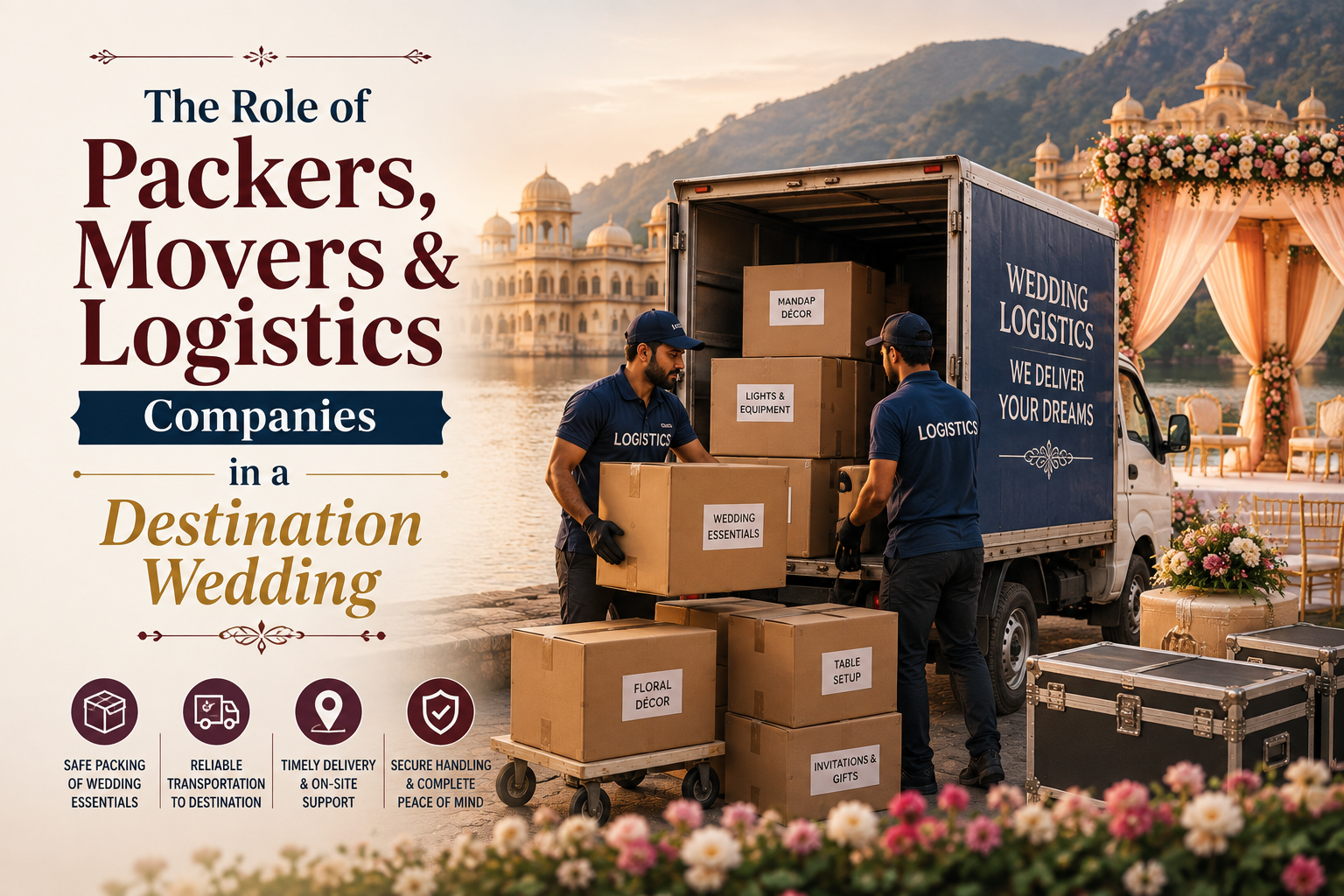
The Role of Packers, Movers & Logistics Companies in a Destination Wedding
Everyone remembers the decorator, the caterer, and the photographer at a destination wedding. Almost nobody thinks about the truck.
But somewhere between your decorator’s Mumbai workshop and your venue in Udaipur, someone has to move a hand-carved mandap, 40 kilos of fresh flowers, crockery for 300 guests, sound equipment, welcome hampers, and every family member’s luggage — on time, undamaged, and in the right order.
And that’s only the event infrastructure. The same journey also has to carry the bride’s lehenga, hand-embroidered and fitted over months, packed so it doesn’t crease. The groom’s sherwani, and his father’s, and his brother’s. The jewellery — heirloom pieces that can’t be re-bought if lost. The trousseau boxes, the mehendi cones and puja thali, the wedding invitations, the return gifts wrapped for 300 guests, the shoes, the accessories, the sacred kalash and other ritual items the priest needs at a specific moment in a specific ceremony. Small things, in other words — but the kind of small things a wedding simply cannot happen without.
That “someone” moving all of it is a logistics company, and how well they do their job quietly decides whether your wedding morning is calm or chaotic.
This is the least glamorous part of destination wedding planning, and also one of the most decisive. Here’s what a packers and movers or event logistics partner actually does, what to look for, and how to plan around it properly.
Why Logistics Matters More at a Destination Wedding
At a local wedding, almost nothing travels far. Your decorator is a 30-minute drive from the venue. If something’s forgotten, someone can fetch it. If a delivery is late by two hours, it rarely breaks the schedule.
None of that safety margin exists at a destination wedding:
- Everything originates somewhere else. Decor, furniture, lighting rigs, and catering equipment are usually sourced from a city, then transported to a venue that may be hundreds of kilometres — or a flight — away.
- There’s no “just send someone to fetch it.” A missing item in Goa can’t be solved by a quick drive across town the way it could at home.
- Timelines are tighter and less forgiving. Vendors often have a fixed, narrow load-in window at the venue, sometimes shared with other events happening the same week.
- Multiple deliveries have to arrive in the right sequence. Mandap structure before florists, flooring before furniture, sound systems before rehearsal — a logistics failure at any one point delays everyone behind it.
- Terrain adds its own complications. Hill destinations like Sikkim and Darjeeling mean narrow mountain roads and load restrictions; beach destinations like Goa, Puri, and Mandarmani mean humidity and sand affecting delicate materials; heritage properties in Rajasthan often restrict vehicle access near the venue itself.
A wedding logistics partner exists to absorb all of this complexity before it reaches you.
What a Wedding Logistics Company Actually Handles
“Packers and movers” undersells what’s actually involved in wedding logistics. A capable partner typically manages:
1. Personal and Ceremonial Items — The Irreplaceable Category
This is the category that matters most and gets talked about least. It includes:
- Bridal wear — the lehenga or saree, often hand-embroidered, structured, and genuinely delicate; it needs to travel on a hanger or in a rigid box, not folded into a suitcase under other luggage
- Groom’s and family sherwanis, suits, and outfits for every ceremony, each one needing the same careful handling
- Jewellery — frequently heirloom pieces, sometimes carried personally rather than shipped, but still requiring a clear plan for who holds it, when, and how it’s secured at each leg of the journey
- Trousseau and gift boxes, mehendi cones, and other bridal-side items prepared weeks in advance
- Ritual and puja items — kalash, thali, sacred threads, and other objects a priest needs at an exact moment in an exact ceremony, where a missing item isn’t just inconvenient, it can hold up the ceremony itself
- Return gifts and favours for the full guest list, usually packed in bulk and easy to underestimate in terms of sheer volume
- Invitation cards, stationery, and small décor accents — easy to treat as an afterthought, genuinely painful to realise are missing on the day
None of this is “cargo” in the way a mandap or a sound system is. It’s personal, sentimental, and in many cases impossible to replace on short notice in an unfamiliar city — which is exactly why it deserves its own line item in the logistics plan, not a spot in the same truck as the catering equipment.
2. Decor and Structural Transport
Mandaps, stage structures, backdrops, furniture, and large installation pieces — often custom-built and irreplaceable on short notice if damaged. This kind of transport demands careful handling, climate-controlled vehicles, and precise timing coordination that regular household movers aren’t necessarily equipped for.
3. Fragile and Perishable Materials
Fresh flowers, glasswork, ceramics, candles, and delicate props need specific packing techniques and, in many cases, temperature control — flowers wilt, glass breaks, and candles melt in transit if handled like ordinary cargo.
4. Catering and Equipment Logistics
Crockery, cutlery, cooking equipment, and bar setups for a few hundred guests is a genuinely large freight load, and it usually needs to arrive a day or more ahead of the event for setup and testing.
5. Guest and Family Logistics
Many destination wedding planners also coordinate transport for guests, the couple, and their families — a fleet that can range from shared buses for guests to a decorated car for the couple on the wedding day itself. This overlaps with, but is distinct from, cargo logistics — it needs its own separate plan.
6. Multi-City and Vendor Coordination
For weddings with vendors and guests arriving from different cities, logistics planning extends to coordinating multi-city travel and liaising with local, destination-specific vendors to keep service quality consistent.
7. Return Logistics
What arrives has to leave again — rented furniture, decor pieces being reused for future events, and family belongings all need a return transport plan, which is easy to forget while everyone’s focused on the wedding day itself.
Specialized Wedding Logistics vs. Regular Packers and Movers
This is the distinction that catches a lot of couples out. Standard packers and movers are built around household and office relocation — packing belongings, using appropriate materials for furniture and electronics, and transporting them safely to a new address. That skill set overlaps with wedding logistics, but doesn’t fully cover it.
A general moving company is usually a good fit for straightforward cargo: extra furniture, personal luggage, gift hampers. But for anything structural, fragile, or time-critical — the mandap, the florals, the stage — you want a provider who has specifically handled event or wedding logistics before, because the packing techniques, vehicle types, and scheduling discipline required are genuinely different from a household move.
A quick way to tell the difference when vendor-hunting: ask directly whether they’ve transported wedding decor or event structures before, and ask for two or three references from actual weddings, not general relocation clients.
What to Look For When Choosing a Logistics Partner
- Event-specific experience. Have they moved mandaps, stage rigs, or florals before — not just furniture and boxes?
- Climate-controlled or covered vehicles, especially for flowers, candles, and anything wax- or fabric-based travelling through hot or humid routes.
- A detailed inventory process. Every item should be logged and photographed before it leaves, both for tracking and for insurance purposes if something goes wrong. Creating a documented inventory with photos before packing genuinely helps if an insurance claim becomes necessary later.
- Transit insurance, separate from your wedding insurance policy (see our guide on wedding insurance for destination weddings) — many logistics providers offer this as a standard add-on, often priced as a small percentage of the declared value of the goods being moved.
- Real-time tracking or a direct point of contact, so your planner isn’t calling a call centre the morning of setup to find out where the truck is.
- GST registration and proper documentation — relevant for both accountability and for any insurance or liability claim later.
- A realistic timeline commitment, not just a delivery date — ask specifically what time on that date, and build in a buffer.
Building the Logistics Timeline
Logistics planning should start the moment vendors are finalized, not the week before the wedding. A rough sequence for a multi-day destination wedding:
| Timeline | What’s Happening |
| 6–8 weeks before | Logistics partner finalized; full inventory of what needs to move is drawn up with every vendor |
| 3–4 weeks before | Transport schedule confirmed — what leaves when, and in what order, based on venue load-in slots |
| 1–2 weeks before | Fragile and perishable-adjacent items (structural decor, non-floral materials) begin transit |
| 2–3 days before | Structural setup (mandap, stage, flooring) arrives and installation begins |
| 1 day before | Florals, catering equipment, and final touches arrive |
| Wedding day | Guest transport and final on-day logistics execute; return logistics plan confirmed for post-event |
| Post-event | Rented items, family luggage, and reusable decor transported back or to next destination |
The specific timing shifts depending on the venue and destination, but the underlying principle doesn’t: structural and heavy items move first, fragile and perishable items move last, and every stage needs a buffer for delays.
Destination-Specific Logistics Considerations
| Destination | Logistics Challenge | What to Plan For |
| Goa | Humidity affecting florals and fabric; monsoon-season road delays | Book climate-aware transport; add buffer days during monsoon months |
| Puri / Mandarmani | Coastal road access, sand affecting equipment | Confirm vehicle access close to the venue; protect equipment from salt air |
| Sikkim / Darjeeling | Narrow mountain roads, landslide-related closures, limited vehicle size | Use smaller vehicles suited to hill roads; build in extra transit days |
| Rajasthan (Udaipur, Jaipur, Jodhpur) | Heritage property access restrictions, extreme heat affecting perishables | Confirm venue’s own vehicle access rules in advance; heat-protect florals and candles |
| North East (Guwahati and beyond) | Longer transit distances from major sourcing cities | Source more materials locally where possible to reduce transit risk |
| International (Phuket, Vietnam, Sri Lanka) | Customs clearance for décor and materials crossing borders | Confirm what can legally be imported; budget extra time for customs |
What Can Go Wrong Without Proper Logistics Planning
Worth naming plainly, because these are avoidable with planning:
- A bridal lehenga creased, stained, or delayed because it travelled folded in general luggage instead of on its own hanger or rigid box
- A mandap arriving hours late because the truck wasn’t built for hill roads, pushing back the entire ceremony
- Fresh flowers wilting in an un-refrigerated vehicle during a long hot-weather transit
- Catering equipment arriving with no time left to test and set up before service
- Guest luggage and event cargo booked on the same vehicle, creating a scheduling conflict neither party expected
- No inventory record, making it impossible to prove what was damaged or missing when something goes wrong
None of these are dramatic, unpredictable disasters — they’re the ordinary, preventable failures of under-planned logistics, and they’re exactly what a competent logistics partner and a realistic timeline exist to prevent.
Frequently Asked Questions
Do I need a separate logistics company, or does my wedding planner handle this? Most full-service destination wedding planners coordinate logistics as part of their service, either managing it directly or bringing in a specialized transport partner. It’s worth confirming this explicitly when you hire a planner, rather than assuming it’s included.
How far in advance should decor transport be booked? Ideally as soon as the venue and decor vendor are finalized — 6–8 weeks out for a destination wedding, so the transport schedule can be built around actual venue load-in slots.
Is transit insurance the same as wedding insurance? No. Transit insurance covers goods while they’re being transported; wedding insurance covers the event itself (cancellation, liability, and so on). A thorough plan includes both — see our detailed guide on wedding insurance for destination weddings for how that works.
Can regular packers and movers handle a destination wedding? For general cargo — luggage, gifts, non-fragile furniture — yes. For structural decor, florals, and anything time-critical, it’s worth specifically hiring or requesting a team with event logistics experience.
What’s the biggest logistics mistake couples make? Treating logistics as an afterthought that gets arranged in the final two weeks, rather than a workstream that starts the moment vendors are confirmed.
How AKK Wedding Planner Handles This
Logistics is one of the parts of a destination wedding you’re least likely to see going right — because when it’s done well, everything simply arrives on time and nobody has to think about it. Our team builds the transport timeline alongside the vendor list from day one, coordinates directly with logistics partners experienced in event transport, and tracks every shipment so your décor, catering equipment, and family’s luggage all land exactly where and when they need to. Planning a destination wedding in Goa, Sikkim, Darjeeling, Rajasthan, or anywhere else on our destination list, and want the logistics handled without the back-and-forth? Get in touch with our team — this is exactly the kind of planning we take off your plate.
Add Comment