
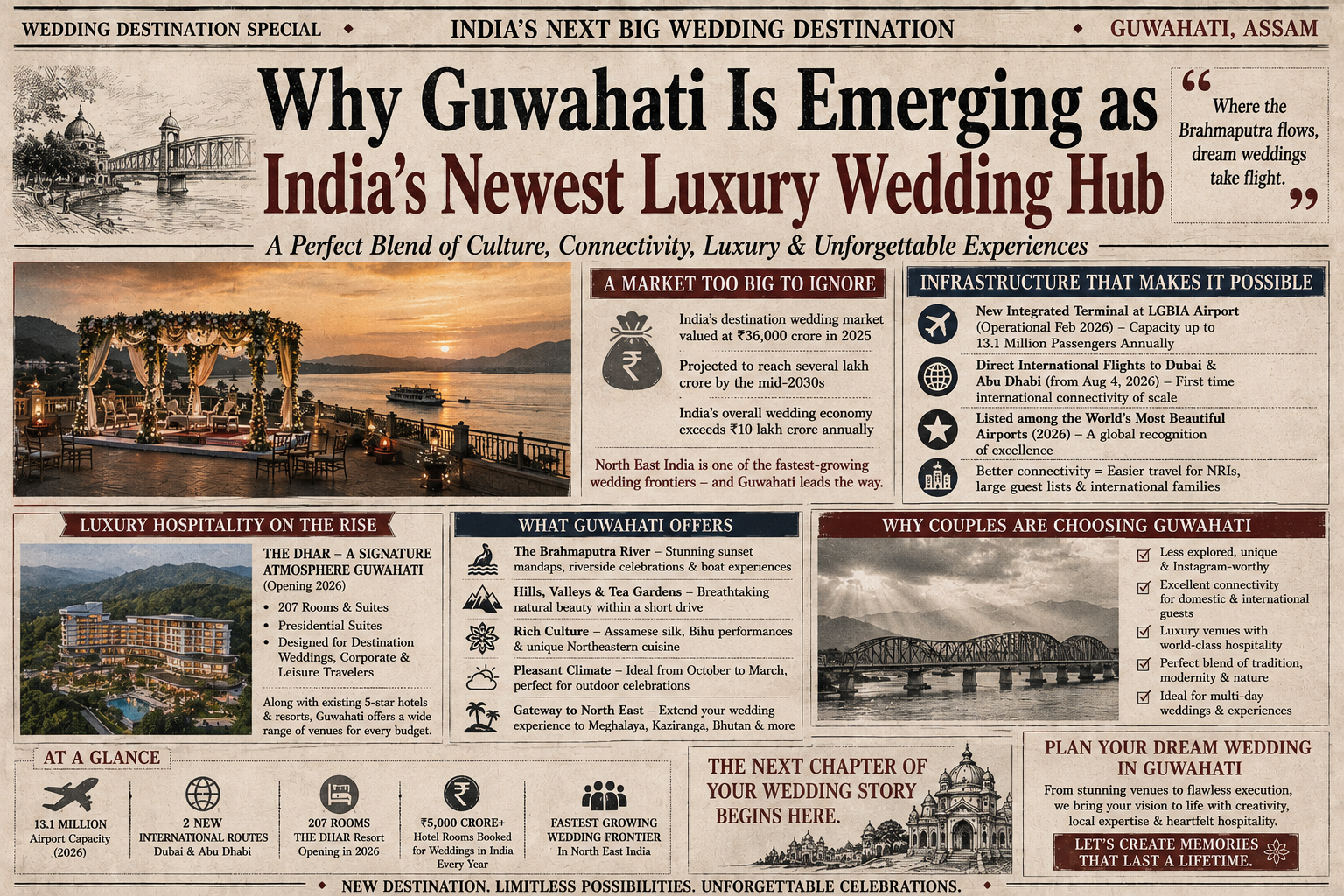
Why Guwahati Is Emerging as India’s Newest Luxury Wedding Hub
For decades, the Indian destination wedding map has been dominated by the usual suspects — the palaces of Udaipur, the beaches of Goa, the havelis of Jaipur. But a new name is steadily working its way into wedding planners’ pitch decks and couples’ Pinterest boards: Guwahati. Perched on the banks of the Brahmaputra and framed by the hills of Meghalaya, Assam’s largest city is transforming from a transit point into a destination in its own right — and the numbers, the infrastructure, and the timing all suggest this shift is just getting started.
A Market That’s Simply Too Big to Ignore
To understand why a city like Guwahati is entering the luxury wedding conversation at all, it helps to zoom out. India’s destination wedding economy is not a niche trend anymore — it’s a genuine industrial category. The domestic destination wedding market was valued at roughly ₹36,000 crore in 2025, with projections pointing toward several lakh crore rupees by the mid-2030s as more families opt for multi-day, out-of-town celebrations. Layer onto that India’s staggering overall wedding economy — often estimated at over ₹10 lakh crore annually — and it becomes clear why every state with scenic terrain and half-decent hotel inventory is now angling to become “the next big wedding destination.”
Industry researchers tracking this space have specifically flagged India’s Northeast — Assam, Meghalaya, Sikkim — as one of the fastest-growing frontiers within this boom, driven by expanding luxury hospitality investment and couples’ hunger for backdrops that don’t look like everyone else’s wedding album. Guwahati, as the region’s largest and best-connected city, sits right at the center of that shift.
The Infrastructure Story: Why Now, Specifically
Destinations don’t become wedding hubs on scenery alone — they become wedding hubs when getting three hundred guests, a live orchestra, a decor team, and a caterer’s worth of equipment into and out of the city stops being a logistical nightmare. That’s exactly what’s happening in Guwahati right now.
A brand-new terminal, and a lot more capacity. In February 2026, the new integrated terminal at Lokpriya Gopinath Bordoloi International Airport (LGBIA) — inaugurated by the Prime Minister in December 2025 — began full commercial operations, lifting the airport’s annual passenger capacity to 13.1 million and cementing its position as the principal aviation gateway to Northeast India. The terminal’s design itself leans into local identity, incorporating motifs like Assam’s kopou phool and Arunachal Pradesh’s Apatani bamboo work — the kind of architectural storytelling that instantly signals “this place has its own culture worth celebrating,” which is precisely the sentiment wedding planners try to sell to clients.
International flights are arriving for the first time in a serious way. Guwahati already connects to Bangkok, Singapore, and Paro (Bhutan). Starting August 4, 2026, Air India began operating direct, non-stop flights from Guwahati to both Dubai and Abu Dhabi — a route addition Assam’s Chief Minister called a step toward making the city “a premier travel and transit hub for Southeast Asia.” For the wedding industry specifically, this matters enormously: a large share of India’s big-ticket destination weddings are driven by NRI families and diaspora clients who want direct international access without routing through Delhi or Mumbai. Guwahati just removed one of the biggest practical objections to hosting a wedding there.
Terminal 2 is getting global recognition. The new terminal has also picked up attention on international “most beautiful airports” lists in 2026 — the kind of soft-power recognition that quietly reassures affluent, image-conscious wedding clients that the destination is polished enough for a five-day guest list.
The Hospitality Pipeline Is Catching Up Fast
An airport alone doesn’t host a wedding — you need rooms, ballrooms, and increasingly, resort-style properties built specifically with events in mind. Guwahati’s luxury hotel pipeline has been moving quickly to close that gap.
Atmosphere Core, in partnership with Meghalaya Infratech Limited, is opening THE DHAR – A SIGNATURE ATMOSPHERE GUWAHATI, a large-scale luxury resort positioned right at the Assam–Meghalaya border, about 45 minutes from LGBIA. The property is being built with 207 rooms and suites — including presidential suites — and, notably, was conceived from the outset with destination weddings as a target market, alongside corporate and leisure travel. That’s a meaningful signal: developers aren’t just hoping weddings show up as incidental banquet business; they’re designing around them.
This sits alongside an existing base of five-star and boutique properties already hosting banquets and marriage functions across the city — from riverside hotels with Brahmaputra views to resort-style venues on the city’s outskirts — giving planners a genuine spread of options across budget tiers, not just a single flagship property. Nationally, the scale of this hotel-for-weddings business is already massive: media reports peg hotel rooms booked for weddings across India at roughly ₹5,000 crore a year, a pipeline Guwahati’s expanding luxury inventory is now positioned to tap into.
What Guwahati Actually Sells: The Backdrop Nobody Else Has
Beyond logistics, there’s a simpler reason Guwahati is gaining traction: it looks like nowhere else on the domestic wedding circuit.
- The Brahmaputra itself. Few Indian cities can offer a wedding backdrop built around one of the world’s great rivers — sunset mandap shots, riverside sangeet stages, and boat-based pre-wedding shoots that photograph unlike anything Rajasthan or Goa can produce.
- Genuine hill-and-valley terrain, with tea estates, forested hills, and the foothills of the Shillong plateau within a short drive, letting planners mix an urban luxury base with a countryside ceremony day.
- A distinct cultural palette. Assamese silk (muga and paat), bihu-inspired performances, and northeastern culinary traditions give wedding planners genuinely new material to work with after years of recycling Rajasthani and South Indian templates for pan-Indian clients.
- A subtropical climate that’s kind to planners. Guwahati stays pleasant across much of the year, with the October-to-March window — already India’s traditional wedding season — lining up comfortably with the city’s most temperate stretch.
- “Gateway to the Northeast” positioning. Guwahati lets couples build a wedding-plus-honeymoon or wedding-plus-holiday itinerary that extends into Meghalaya’s living root bridges, Kaziranga’s wildlife, or Bhutan itself — feeding directly into the broader Indian trend toward multi-experience, honeymoon-adjacent destination weddings.
Where This Fits in the Bigger National Trend
None of this is happening in isolation. It’s arriving at the exact moment the Indian destination wedding industry is actively hunting for its next wave of locations. Established venues — Udaipur, Jaipur, Goa — are increasingly seen as saturated or overexposed, pushing planners and affluent clients toward newer terrain: the Andamans for island weddings, and Northeast India — Meghalaya, Sikkim, and now Assam — as the “undiscovered” luxury frontier. Industry trend reports for 2026 explicitly name Northeast India among the emerging destinations gaining share as hospitality investment expands, alongside a broader industry shift toward fewer, larger, more curated single-location events rather than multiple smaller functions spread across cities.
Guwahati is positioned to be the practical anchor of that Northeast wave — the city with the airport, the hotel rooms, the international flights, and the urban infrastructure to actually execute a five-hundred-guest wedding, while still offering a jumping-off point into more remote, scenic corners of the region for pre-wedding shoots and add-on experiences.
The Road Ahead
It would be premature to call Guwahati a finished luxury wedding destination on par with Udaipur or Jaipur — its hotel inventory, while growing, is still smaller, and much of the current infrastructure push (the new terminal, the Dubai/Abu Dhabi routes, THE DHAR resort) has only landed in the last several months of 2026. But that’s precisely what makes it interesting: the foundational pieces — air connectivity, luxury room inventory, and national industry appetite for new Northeast destinations — have all clicked into place within a remarkably short window.
For couples chasing a wedding backdrop their guests haven’t already seen a dozen times on Instagram, and for planners looking for the next city to build a specialty practice around, Guwahati’s timing looks less like a fluke and more like a city catching up to demand that was already there.
Add Comment