
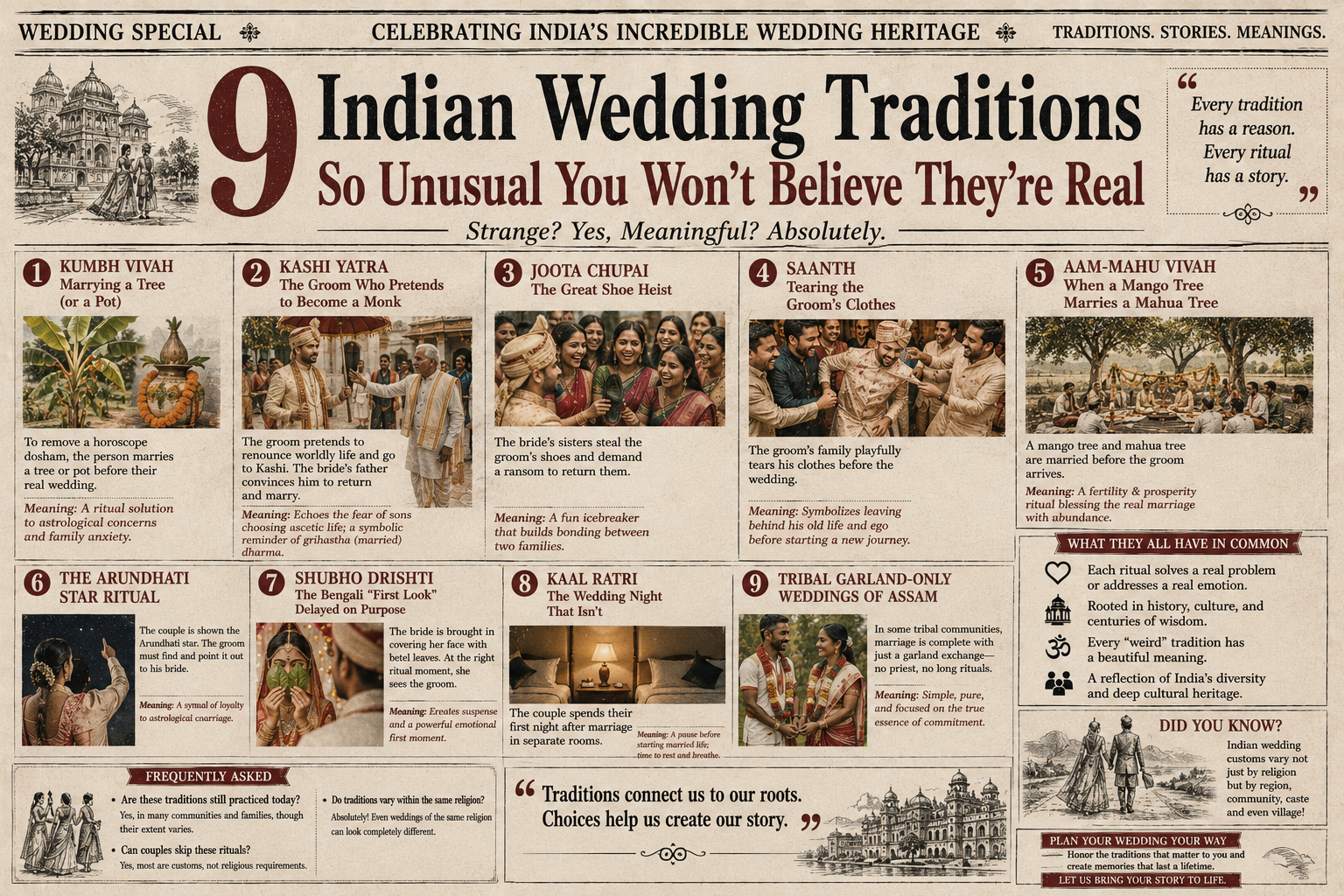
9 Indian Wedding Traditions So Unusual You Won’t Believe They’re Real
Every wedding culture has its quirks, but India’s regional wedding traditions take “quirky” to a genuinely different level — grooms who pretend to become monks mid-ceremony, brides who marry trees before they marry their actual partner, and rituals that exist purely to extract money from an amused groom. None of this is folklore or exaggeration. These are real, still-practiced customs, and every single one of them has a surprisingly sensible story behind it once you know what you’re looking at.
Here are nine of the most genuinely unusual — and their actual meanings.
1. Kumbh Vivah: Marrying a Tree (or a Pot) Before Your Actual Wedding
In several parts of North India, particularly Uttar Pradesh and Bihar, a person born under a specific unfavorable astrological placement — known as Manglik dosha — is believed to bring misfortune to their future spouse. The solution: marry a banana tree, a peepal tree, or a sacred pot (kumbh) first, in a full mock ceremony complete with rituals. The tree or pot is symbolically married, sometimes then cut down or immersed in water, and the astrological “curse” is considered transferred away from the human marriage that follows.
Why it actually makes sense: Whatever you think of the astrology itself, the ritual solves a real social problem — it gives anxious families a culturally sanctioned way to proceed with a marriage they might otherwise call off over a horoscope mismatch. It’s less superstition for its own sake and more a pressure-release valve built into the tradition.
2. Kashi Yatra: The Groom Who Pretends to Become a Monk
In several South Indian wedding traditions, particularly Tamil and Telugu ceremonies, the groom dramatically pretends to renounce worldly life and set off on a pilgrimage to Kashi (Varanasi) to become a spiritual ascetic — literally turning and walking away from the wedding, umbrella and walking stick in hand. The bride’s father then intercepts him, persuades him that married life is the better path, and “convinces” him to return and marry his daughter.
Why it actually makes sense: According to wedding historians, this ritual has real roots in old Brahmin family anxiety about sons abandoning worldly life for asceticism or renunciation altogether — a genuine concern in earlier eras. What looks like theatre today is a symbolic echo of a very real historical fear, now performed as a lighthearted piece of ceremonial drama.
3. Joota Chupai: The Great Shoe Heist
At North Indian Hindu weddings, while the groom sits through the ceremony, his shoes are quietly stolen by the bride’s sisters and female cousins — and held hostage until he pays a (often comically negotiated) ransom to get them back.
Why it actually makes sense: Beyond the fun, it’s a structured way to break the ice between the two families, particularly the groom and his new set of sisters-in-law, through a low-stakes game of banter and negotiation right at the start of a lifelong relationship.
4. Saanth: The Sindhi Ritual of Tearing the Groom’s Clothes
In Sindhi weddings, a pre-wedding ceremony called saanth involves the groom’s own family playfully tearing his clothes — a deliberately symbolic act representing him leaving his old, unmarried life behind before stepping into a new one.
Why it actually makes sense: It’s a physical, visceral version of a transition ritual most cultures handle more quietly — literally shedding your old identity, staged as a piece of family theatre rather than left as an abstract idea.
5. Aam-Mahu Vivah: When a Mango Tree Marries a Mahua Tree
In the Maithil wedding traditions of the Mithila region (Bihar, and parts of Nepal), before the groom’s procession even arrives at the bride’s home, a mango tree and a mahua tree are ceremonially married to each other in the bride’s village.
Why it actually makes sense: It’s a fertility and prosperity ritual tied to agrarian life — the union of two trees, each associated with abundance in local tradition, is believed to bless the actual human marriage that follows with similar prosperity. It’s a reminder of how deeply many Indian wedding customs are rooted in older agricultural and land-based belief systems, not just religious ones.
6. The Arundhati Star Ritual
In several South Indian Hindu weddings, particularly Telugu ceremonies, the priest takes the newly married couple outside under the open night sky after the ceremony and points out a specific, hard-to-spot star: Arundhati, wife of the sage Vashistha, one of the seven sages associated with the star constellation. The groom is then asked to locate and point out the same star to his new wife.
Why it actually makes sense: Arundhati is traditionally held up as a symbol of marital devotion and loyalty in Hindu mythology. The ritual is a quiet, poetic way of setting an aspiration for the marriage — not a demand, just a shared moment of looking at the same small, steady point of light together.
7. Shubho Drishti: The Bengali “First Look,” Delayed on Purpose
In Bengali Hindu weddings, the bride is carried to the mandap on a decorated wooden platform (piri) while covering her face with betel leaves, deliberately concealing herself from the groom until the exact ritual moment — shubho drishti, the “auspicious first sight” — when the leaves are lowered and the couple see each other’s faces for the first time in the ceremony.
Why it actually makes sense: In a wedding format built almost entirely around ceremony and symbolism, this ritual manufactures a genuine moment of suspense and emotion — deliberately withholding something small so the reveal actually lands, in a wedding where the couple, in many traditional arranged-marriage contexts historically, may not have seen much of each other before.
8. Kaal Ratri: The Wedding Night That Isn’t
Also from Bengali tradition, the newly married couple’s first night in their new home together — kaal ratri — is spent deliberately apart, in separate rooms, despite technically being married.
Why it actually makes sense: It’s a small, built-in pause between the ceremony’s intensity and married life actually beginning — a single night’s breathing room before the next phase starts, rather than expecting an immediate, seamless transition.
9. Tribal Garland-Only Weddings of Assam
In several tribal communities of Assam, the entire marriage ceremony can be as simple as the bride and groom exchanging garlands with each other — no priest, no elaborate multi-hour ritual sequence, no mangalsutra-tying ceremony. The garland exchange alone constitutes the marriage.
Why it actually makes sense: It’s a useful reminder that “Indian wedding” doesn’t have one default complexity level — plenty of India’s own communities treat marriage as something that can be marked simply and briefly, standing in real contrast to the elaborate, multi-day format most people picture when they hear “Indian wedding.”
What These Traditions Actually Have in Common
Look past the individual strangeness and a pattern shows up: almost none of these rituals exist purely for spectacle. Each one is solving a real, specific problem — an astrological anxiety, a family transition, an icebreaker between in-laws, a moment of manufactured suspense, a night of rest before married life begins. The “weirdness” is really just specificity: a culture with thousands of years of wedding tradition has had a very long time to develop very particular solutions to very particular emotional and social needs.
That’s worth remembering the next time a tradition in your own family’s wedding plans seems unusual to an outsider — it almost certainly started as someone’s genuinely thoughtful answer to a real question, even if the “why” got lost somewhere over a few centuries of just doing it because it’s always been done.
Frequently Asked Questions
Are these traditions still commonly practiced today? It varies widely by region, family, and how traditional a wedding is overall — some, like joota chupai, remain extremely common across North Indian weddings; others, like Kumbh Vivah, are practiced specifically when an astrological concern applies, not as a default.
Can couples choose to skip these rituals? Generally yes — most of these are family and regional customs rather than religious requirements, and many modern couples selectively keep the ones that feel meaningful to them while skipping others. It’s worth an honest conversation with both families early in planning rather than assuming everyone expects the same rituals.
Do these traditions vary a lot even within the same religion or region? Significantly — Indian wedding customs are shaped as much by specific community, caste, and local history as by broader religious tradition, which is exactly why two Hindu weddings from different states can look almost entirely different from each other.
Planning a Wedding That Honors What Actually Matters to Your Family
Every family has their own version of “the tradition we’re definitely keeping” and “the one we’re happy to skip” — and a good planner’s job is knowing the difference, and how to weave the ones you want seamlessly into the rest of the day. Get in touch with our team to plan a wedding that reflects exactly the traditions that matter to you, wherever they come from.
Add Comment