Boho, Royal, or Minimalist? Choosing Your Wedding Theme
Boho, Royal, or Minimalist? Choosing Your Wedding Theme
Somewhere around the second or third mood board, most couples hit the same wall: everything looks beautiful, and none of it looks like a decision. Boho feels romantic. Royal feels unforgettable. Minimalist feels calm and elegant. Pinterest is no help — it will happily feed you all three in the same scroll.
The good news is that these three themes aren’t actually competing for the same couple. Each one solves a different problem, suits a different kind of celebration, and comes with real, practical trade-offs beyond just aesthetics. Here’s an honest breakdown of all three — including how they’re evolving in 2026 — to help you actually land on one.
Boho: Free-Spirited, Nature-Led, and More Sophisticated Than It Used to Be
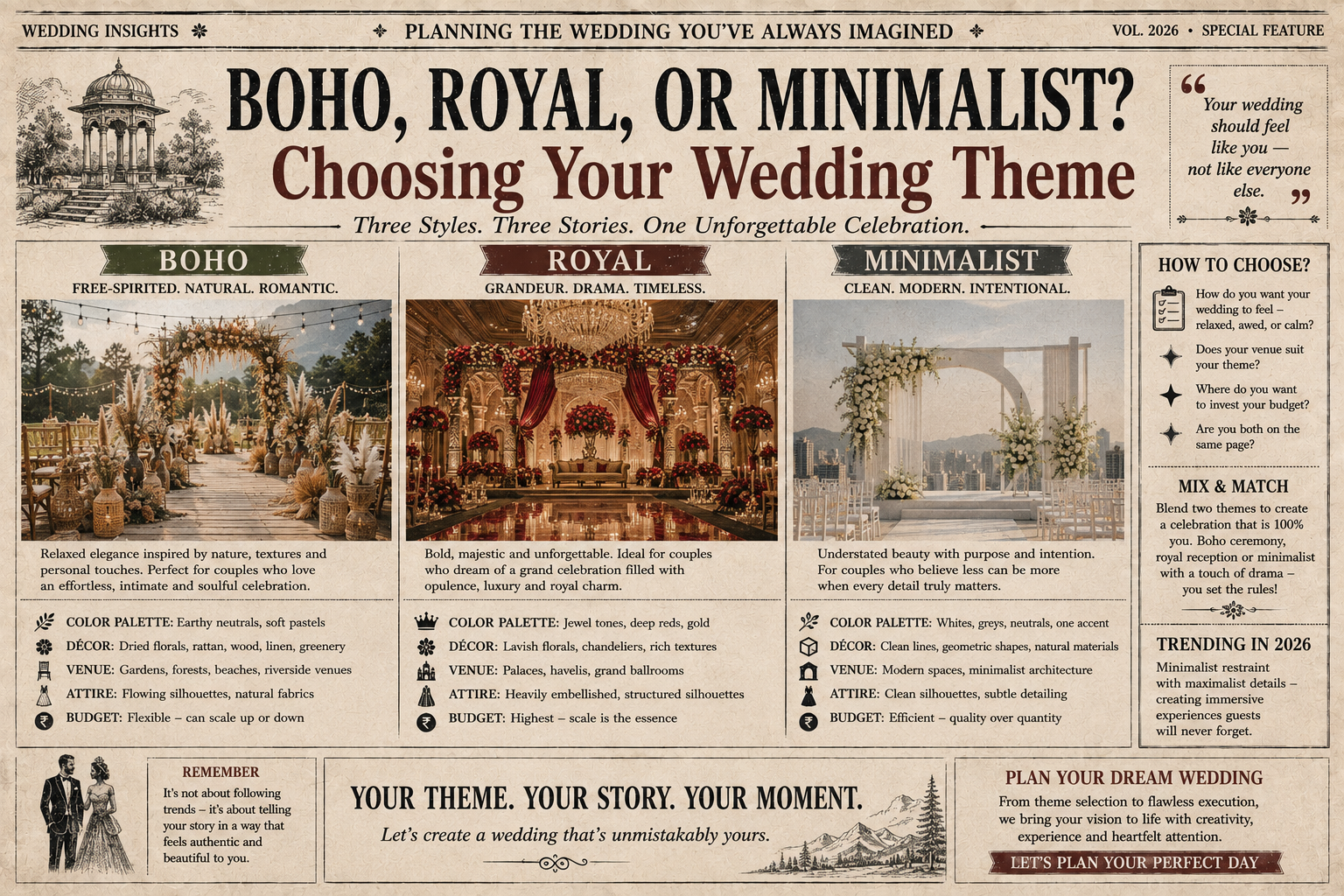
If your instinct is “relaxed but still beautiful,” boho is probably your starting point. But it’s worth knowing that boho in 2026 looks meaningfully different from the flower-crowns-and-macramé version that defined the style a decade ago. Wedding stylists are now describing a “new boho” — moving away from 2010s festival aesthetics toward elevated minimalism, artisanal craftsmanship, and a more tactile, personal feel, rather than a specific set of props.
Color palette: Earthy neutrals — terracotta, sage, sand, dusty rose — often layered with natural textures rather than bold contrast.
Décor elements: Dried and fresh florals mixed together, natural materials (rattan, wood, linen), asymmetrical floral installations rather than perfectly matched arrangements, and a general preference for “gathered” over “arranged.”
Venue fit: Outdoor and nature-adjacent settings genuinely elevate this theme — a forest, a garden, a beach, or (for AKK’s own destinations) the Dooars’ riverside and forest-edge venues suit boho far better than a formal ballroom.
Attire: Flowing silhouettes, natural fabrics like chiffon and lace, and detail-rich but unstructured pieces — bishop sleeves, botanical embroidery, backless designs that prioritize ease of movement over formal structure. For Indian brides, this often translates into pastel or earth-toned lehengas with flowing dupattas rather than heavily structured, stiff silhouettes.
Who it suits: Couples who want their wedding to feel personal and unforced rather than perfectly symmetrical — and who are genuinely comfortable with a slightly imperfect, “gathered” aesthetic rather than polished uniformity.
Budget reality: Boho can be genuinely budget-flexible — dried florals, secondhand or repurposed décor, and DIY-friendly elements can lower costs meaningfully — but a high-end “elevated boho” look with artisanal craftsmanship and premium natural materials can cost just as much as a more traditional theme.
Royal: Grandeur, Drama, and Maximalist Storytelling
If your instinct is “I want people talking about this years later,” royal is your theme. It’s built entirely around scale, richness, and a sense of occasion — and 2026’s version leans even further into “maximalist romance,” with couples embracing bold, layered, sensory design rather than restrained elegance.
Color palette: Deep jewel tones — emerald, burgundy, sapphire, gold — often with heavy metallic accents.
Décor elements: Elaborate florals (think abundant, sculptural arrangements rather than sparse ones), ornate furniture, dramatic lighting (chandeliers, candlelight), and richly layered tablescapes — 2026’s dinner tables specifically are trending toward “unapologetically maximalist,” with texture-rich menus, sculptural centerpieces, and an immersive, experiential feel even when the rest of the event is more restrained.
Venue fit: Heritage palaces and havelis are the natural home for this theme — Rajasthan’s Udaipur, Jaipur, and Jodhpur properties are essentially built for it, though a well-decorated ballroom or resort can achieve a similar effect with the right lighting and drapery investment.
Attire: Structured, richly embellished lehengas and sherwanis — heavy embroidery, statement jewellery, and formal silhouettes that photograph as “grand” rather than “relaxed.”
Who it suits: Couples who want a wedding that feels like an event, not just a celebration — and who are comfortable with (and budgeting for) real scale, since this theme rarely works well scaled down.
Budget reality: This is consistently the most expensive of the three themes to execute well. Heritage venues, elaborate florals, and premium catering and staging all carry real costs that don’t compress easily — trying to do “royal” on a tight budget usually shows in the final result more than it would with the other two themes.
Minimalist: Restraint, Intention, and Quiet Confidence
If your instinct is “less, but make it perfect,” minimalist is your theme. It’s the theme most likely to be misunderstood as “boring” by people who haven’t seen it done well — but 2026’s minimalist weddings are being described by designers as gallery-like: sparse, but with every single piece deliberately chosen and meaningful. The phrase doing the rounds among wedding designers this year is “minimal clutter, maximal intention” — restrained at first glance, with real richness revealing itself on closer inspection.
Color palette: Neutrals — white, black, grey, nude — sometimes with a single considered accent color rather than a full palette.
Décor elements: Clean lines, geometric shapes, and natural materials like wood, stone, and glass used sparingly rather than layered. Centerpieces are simple but never careless — every object earns its place.
Venue fit: Architecturally interesting spaces work best here — modern resorts, clean-lined heritage properties, or any venue with good natural light and strong bones, since minimalist décor has nowhere to hide a mediocre space the way maximalist décor can.
Attire: Clean silhouettes, minimal embellishment, and a focus on fabric quality and fit over embroidery volume — for Indian weddings, this often means a more contemporary lehenga or saree with subtle detailing rather than heavy zardozi work.
Who it suits: Couples who want their wedding to feel calm, considered, and personal — and who are comfortable resisting the pressure to add “just a bit more” décor, which is the single easiest way to accidentally undermine this theme.
Budget reality: Minimalist can be genuinely cost-efficient, since you’re paying for fewer elements — but each element needs to be higher quality, since there’s nowhere for a cheap detail to hide in a sparse space. It’s a theme that rewards spending on a few excellent things rather than many adequate ones.
Side-by-Side Comparison
| Factor | Boho | Royal | Minimalist |
| Color palette | Earthy neutrals, natural tones | Deep jewel tones, gold | Whites, greys, single accent color |
| Best venue type | Outdoor, nature-adjacent | Heritage palace, haveli, grand ballroom | Architecturally clean, well-lit spaces |
| Attire feel | Flowing, relaxed, textural | Structured, richly embellished | Clean-lined, subtly detailed |
| Typical budget range | Flexible — can scale up or down | Highest — scale is core to the look | Efficient — pay for quality over quantity |
| Best suited to | Personal, unforced, nature-loving couples | Couples wanting scale and drama | Couples wanting calm, considered elegance |
| 2026 evolution | “New boho” — more elevated, artisanal | Maximalist tablescapes, immersive detail | Gallery-style “minimal clutter, maximal intention” |
The Fourth Option: Blending Two Themes
It’s worth naming directly, because it’s exactly where 2026 wedding design is actually heading: the sharpest divide this year isn’t really boho versus royal versus minimalist — it’s a growing trend of minimalist restraint paired with maximalist detail in specific moments. A largely minimalist reception with one boldly maximalist tablescape. A boho ceremony backdrop with a more structured, richly embellished reception outfit change. Royal-level jewellery paired with an otherwise clean, minimalist décor palette.
You don’t have to pick exactly one lane. The most personal weddings often borrow the parts of each theme that genuinely reflect the couple, rather than committing to one aesthetic label across every single decision.
How to Actually Decide
A few honest questions, beyond “which mood board do I like more”:
How do you actually want people to feel walking in — relaxed, awed, or calm? That instinctive answer usually points more accurately to boho, royal, or minimalist than any color palette comparison will.
What’s your venue, and does it fight your theme? A modern, clean-lined resort will resist a heavy royal treatment; a Rajasthan heritage palace will feel oddly bare with a minimalist approach. Choosing a theme your venue already leans toward saves both money and stress.
Where do you actually want to spend? Royal demands spending on scale. Minimalist demands spending on quality over quantity. Boho is the most genuinely flexible on where the budget goes. Be honest about which of these matches how you actually want to allocate money, not just which looks best in photos.
Do both partners agree, or is one theme really just one person’s vision? This sounds obvious, but theme disagreements are one of the most common sources of wedding planning friction — better to surface it early through this kind of direct comparison than mid-way through booking vendors.
Frequently Asked Questions
Can I mix boho and minimalist? Yes, and it’s an increasingly common and well-regarded combination — natural, textural boho elements paired with a more restrained, minimalist overall palette rather than a maximalist boho approach.
Is a royal theme only possible at a palace venue? No, though it’s genuinely easier there. A well-executed royal theme at a non-heritage venue relies more heavily on lighting, drapery, and furniture rental investment to create the same sense of grandeur a palace provides architecturally.
Which theme is easiest to execute on a tighter budget? Minimalist and boho are both more budget-flexible than royal, for different reasons — minimalist because you’re buying fewer elements, boho because natural and secondhand materials fit the aesthetic rather than working against it.
Does the theme need to match across every single wedding function? Not necessarily — many couples vary the theme intensity across functions (a relaxed boho mehendi, a more structured minimalist or royal reception), as long as the overall palette and feel stay connected rather than feeling like three unrelated events.
Find Your Theme With AKK
Choosing a theme isn’t really about picking a Pinterest aesthetic — it’s about matching your venue, your budget, and how you actually want your wedding to feel, into one coherent decision. Get in touch with our team and we’ll help you land on the theme that’s genuinely right for you, not just the one that’s trending this year.
Add Comment