Corporate Events vs Weddings: How Event Planning Really Differs
At a glance, a corporate gala and a wedding reception look like the same job. Both need a venue, a caterer, a decorator, lighting, sound, and someone running a timeline behind the scenes so nothing falls apart in front of guests. Hire the same planning company for both, and on paper, the skill set looks identical.
It isn’t. The venue and vendors might overlap, but the strategy underneath them is built on almost opposite logic — who decides, why they’re deciding, what “success” even means, and how much room there is for personal taste versus brand discipline. Understanding that difference matters whether you’re hiring a planner for either kind of event, or simply curious why your wedding planner and your company’s event manager seem to be speaking two different languages.
Here’s the full breakdown.
1. The Core Purpose Is Entirely Different
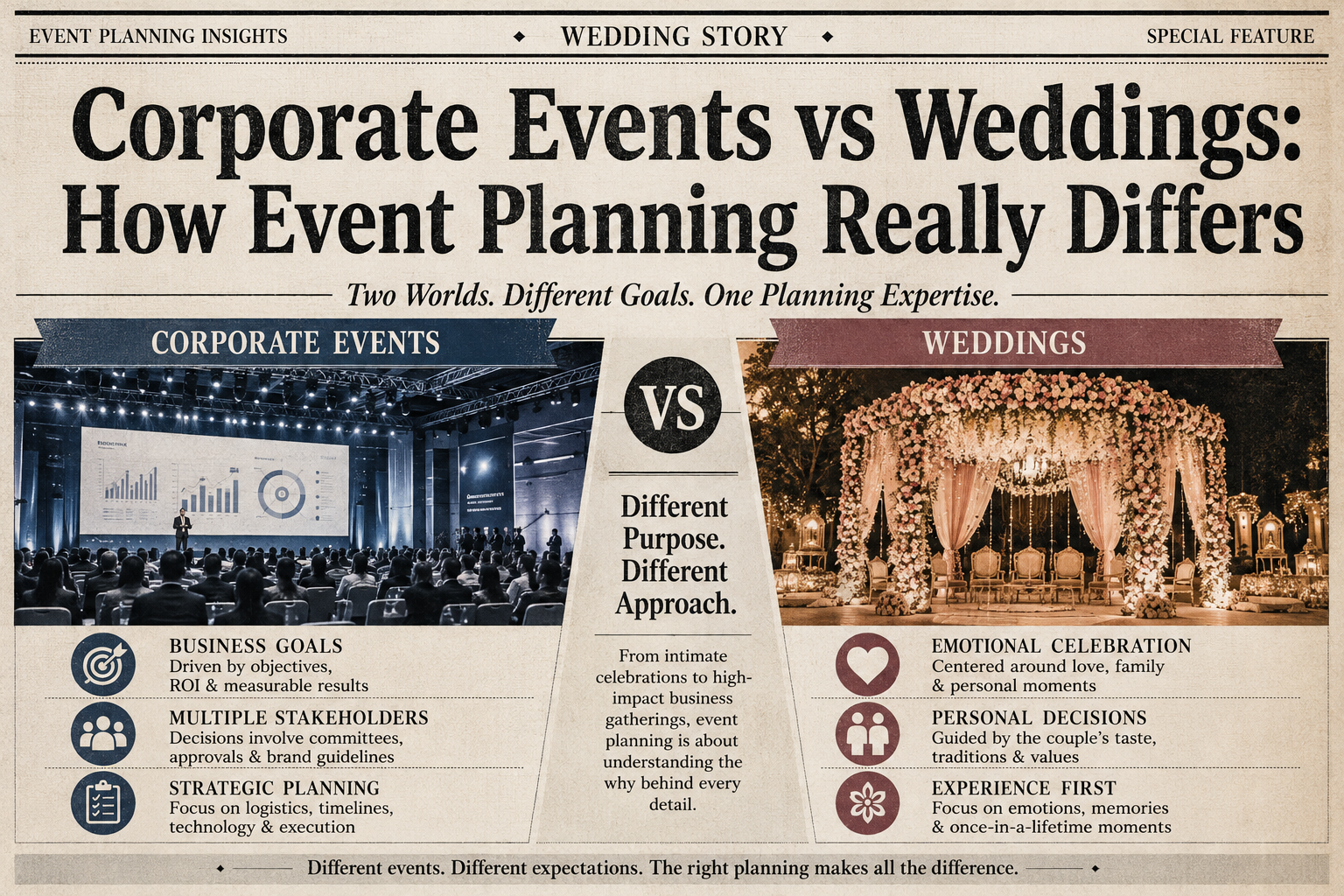
A wedding exists to celebrate a relationship — a couple’s commitment, their families coming together, a personal milestone that happens once. Every decision, from the flowers to the food, is ultimately in service of that emotional purpose.
A corporate event exists to serve a business outcome — networking, brand visibility, employee recognition, a product launch, client relationships. It’s not that corporate events have no emotional content (a good one absolutely does), but the emotion is in service of a business goal, not the other way around.
This single difference — celebration versus objective — is the root of almost every other distinction on this list.
2. Who Actually Makes the Decisions
Wedding decisions typically run through a small, personal circle: the couple, and often parents who are emotionally and sometimes financially invested. Decisions are frequently driven by personal taste — a couple loves a particular flower, dislikes a particular music genre, wants a specific ritual honored a specific way. A planner’s job is to shape those personal preferences into a cohesive experience, not to override them.
Corporate events rarely have a single decision-maker. Planners typically answer to a committee — a marketing director, an HR lead, a CEO’s office, sometimes a board — and decisions are filtered through brand guidelines, budget approval chains, and business logic rather than personal preference. A CEO’s favorite color doesn’t override the company’s brand palette. This also means corporate planners spend real time “managing upward,” building consensus and sign-off across multiple stakeholders before a single decision is final.
3. Budget Logic: Emotional Value vs. Measurable ROI
Wedding budgets are set once, largely upfront, and tend to flex around what matters most emotionally to the couple — even if that means cutting elsewhere to spend more on the one thing (the venue, the photographer, the bridal outfit) that genuinely matters to them. There’s no return-on-investment calculation for a wedding; the “return” is the experience itself.
Corporate budgets are tied directly to business impact. Spending gets evaluated against measurable outcomes — leads generated, employee satisfaction scores, media coverage, attendee counts against targets — and budgets are usually predetermined by finance or procurement rather than adjusted mid-planning based on emotional priority. This also means corporate events face more competitive vendor bidding and tighter budget accountability, with detailed expense tracking and variance reporting expected by leadership afterward. (In India specifically, there’s also a practical GST distinction worth knowing: corporate clients are typically GST-registered and can claim input tax credit, while individuals paying for a wedding bear the GST as a straightforward final cost — which effectively changes the real spending power behind the same headline budget.)
4. Design and Décor Philosophy
Wedding décor is personal by design. It should reflect the couple’s specific story, taste, and — in India especially — cultural and family traditions. Design decisions often start with a mood board and evolve into something highly specific to these two people: their colors, their flowers, their rituals, their families’ expectations.
Corporate décor is strategic and brand-led. Furniture layout is designed around networking flow and functional needs — breakout areas, product displays, stage sightlines — more than aesthetic romance. Every visual choice typically needs to align with brand guidelines: colors, logos, tone, and messaging consistency matter more than personal beauty preferences, because the event is representing an organization, not two individuals.
5. Guest Experience Goals
Wedding guests are close friends and family, and the experience is built around intimacy and personal connection — a seating chart designed around family dynamics, a menu built around what the couple and their families actually love, small details that feel deeply personal rather than generic.
Corporate guests are often colleagues, clients, or industry contacts who may not know each other well, and the experience is designed to facilitate professional interaction — networking-friendly layouts, structured agendas, clear takeaways. The event needs to reflect professionalism and brand credibility as much as it needs to be enjoyable.
6. Timeline and Planning Horizon
Weddings, especially full-service destination weddings, often involve the longest lead times of any event category — commonly 12 to 24 months — because of the sheer number of bespoke, in-demand vendors (venues, photographers, decorators) that book up far in advance, plus the emotional weight of getting every detail right for a once-in-a-lifetime event.
Corporate events are typically project-based, running anywhere from a few months to about a year depending on scale, or planned on an ongoing retainer basis for companies that run recurring events. Scale and complexity tend to matter more than category — a 500-person conference generally needs more lead time than a 30-person private dinner, corporate or otherwise — but corporate timelines are usually driven by a fixed business date (a product launch, a fiscal year-end) rather than the more flexible, tradition- and auspicious-date-driven scheduling common in Indian weddings.
7. Vendor Relationships and Technology Needs
Wedding vendor selection is guided by aesthetic fit and personal chemistry as much as logistics — couples often want a photographer or decorator whose style and personality they connect with, not just their portfolio.
Corporate clients tend to prioritize production-quality AV, staging, and technical infrastructure above aesthetic charm, because the technical execution directly reflects on the business — a glitchy livestream or bad microphone at a product launch is a visible, memorable failure in a way it isn’t at a wedding reception. Corporate events also lean more heavily on repeatable formats and vendor relationships built for consistency across multiple events, rather than a single bespoke vendor experience.
8. Measuring Success
There’s no KPI for whether a wedding felt magical — and that’s precisely the point. Success is subjective, emotional, and entirely defined by whether the couple and their families felt the day reflected them. A planner’s job is to deliver an experience the client often can’t fully articulate until they’re standing in the middle of it.
Corporate events are measured against concrete benchmarks set before the event even happens — attendance targets, lead generation, media impressions, post-event survey scores, budget variance. Success is something you can put in a report to leadership, not just a feeling in the room.
Side-by-Side Comparison
| Factor | Wedding | Corporate Event |
| Core purpose | Celebrate a relationship and milestone | Achieve a business or organizational goal |
| Decision-makers | Couple, sometimes parents | Committee, executives, multiple stakeholders |
| Budget logic | Emotionally prioritized, flexible allocation | ROI-driven, predetermined, tightly tracked |
| Décor philosophy | Personal, story-driven | Brand-aligned, functional |
| Guest experience goal | Intimacy and personal connection | Networking and professional engagement |
| Typical lead time | 12–24 months | 3–12 months (varies by scale) |
| Vendor selection driver | Aesthetic fit and personal rapport | Technical reliability and consistency |
| Success measurement | Subjective, emotional | Concrete KPIs and post-event reporting |
| Tax treatment (India) | GST borne as final cost | GST-registered, often reclaimable |
Why This Matters If You’re Hiring a Planner
If a planner’s entire portfolio is weddings, that doesn’t automatically make them a poor fit for your company’s annual conference — but it does mean the underlying skill set they’ll need to flex is genuinely different: managing a stakeholder committee instead of a couple, building measurable outcomes into the plan instead of an emotional experience, and prioritizing AV and technical execution over romantic atmosphere.
The reverse is just as true. A planner who’s excellent at corporate logistics and brand alignment may not naturally have the emotional intelligence, family-dynamics diplomacy, and personalization instincts a wedding demands.
The strongest planning teams — and this is genuinely one of the more useful things to ask about when you’re hiring one — treat these as two distinct disciplines with some shared logistical DNA, rather than assuming one skill set automatically covers the other.
Frequently Asked Questions
Can the same company handle both weddings and corporate events well? Yes, but it’s worth asking directly how they structure their teams — the best firms treat these as related but distinct specializations, often with planners who lean toward one or the other, rather than assuming every planner on staff is equally suited to both.
Which is more expensive — a wedding or a corporate event? Neither is inherently more expensive; both range widely by scale. Wedding budgets are shaped by what matters emotionally to the couple, while corporate budgets are shaped by predetermined organizational spending and expected business return — the deciding factor is scale and ambition, not category.
Why do corporate events focus so much more on AV and technology? Because the technical execution is directly visible and directly reflects on the business hosting it — a failed livestream or bad sound system at a product launch is a public, memorable failure in a way a wedding’s technical hiccups usually aren’t.
Do corporate events need less personalization than weddings? Less personal, not necessarily less personalized — corporate events are highly customized to a brand’s identity and goals, just not to an individual’s personal taste the way a wedding is.
How AKK Handles Both
We plan both because the overlap in logistics — venues, vendors, timelines, execution — is real, but we don’t run them off the same playbook. Wedding planning gets our full emotional and cultural attention: family dynamics, personal story, tradition. Corporate events get a different discipline entirely: stakeholder management, brand alignment, measurable outcomes, and the kind of technical reliability a business event can’t afford to get wrong.
Whether you’re planning a wedding or your company’s next big event, get in touch with our team — we’ll bring the right playbook to the table, not a one-size-fits-all approach.
Add Comment