
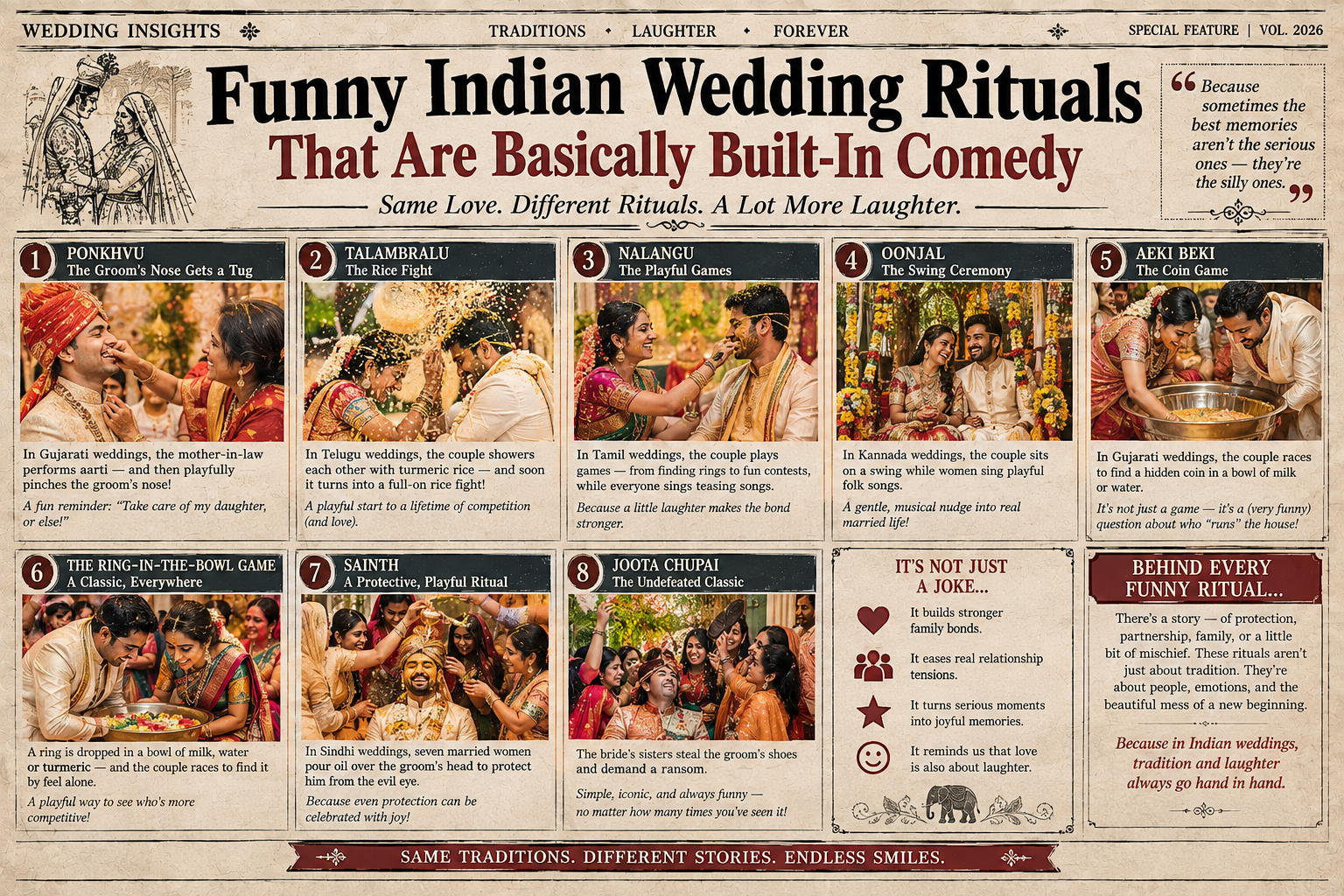
Funny Indian Wedding Rituals That Are Basically Built-In Comedy
Indian weddings have a reputation for being solemn, sacred, and steeped in centuries of ritual — which is true, right up until the exact moment the priest steps back and someone’s mother-in-law starts playfully yanking the groom’s nose in front of 200 guests. Almost every Indian wedding tradition, regardless of region or religion, has at least one ritual that exists purely to make people laugh. Not accidentally funny — deliberately, structurally built to be comedy.
Here’s a tour of some of the best ones, and the surprisingly thoughtful reason nearly every wedding tradition in India makes room for at least one moment of pure, sanctioned silliness.
1. Ponkhvu: The Ritual Where the Mother-in-Law Pulls the Groom’s Nose
In Gujarati weddings, when the groom arrives at the wedding venue, his soon-to-be mother-in-law performs an aarti to welcome him — and then, mid-blessing, playfully pinches or pulls his nose in front of everyone.
Why it’s not just a prank: The gesture is a lighthearted but pointed reminder — essentially, “take good care of my daughter, or else” — delivered as affection wrapped in mild threat, which is somehow exactly the right tone for a mother-in-law’s first official act toward her new son-in-law.
2. Talambralu: The Rice Fight Everyone Pretends Is Just a Ritual
In Telugu weddings, the bride and groom shower each other with talambralu — rice mixed with turmeric — poured gently over each other’s heads. For the first few rounds, everyone plays along solemnly. Then, without fail, it turns into an all-out competitive rice-dumping contest, each partner trying to bury the other in as much rice as physically possible, to the delighted screaming of every guest watching.
Why it’s not just a prank: It’s one of the most photographed moments of a Telugu wedding for good reason — it’s the first genuinely unscripted, competitive interaction the couple has in front of their families, and it usually reveals more real personality in thirty seconds than the entire ceremony before it.
3. Nalangu: The Ceremony That’s Deliberately “Unserious”
Tamil weddings build an entire ceremony around comic relief: after hours of Sanskrit chanting and formal ritual, the couple is seated facing each other and made to play a series of games in front of both families — finding a ring hidden in a bowl of turmeric water, or other lighthearted contests — while women sing traditional nalangu paatu songs that gently tease both the bride and groom throughout.
Why it’s not just a prank: It’s genuinely the first moment in the entire wedding sequence where the couple does something together that isn’t instructed by a priest — every other ritual up to that point has them sitting, being guided, and performing set actions. Nalangu is the one deliberate pocket of real, unscripted interaction, which is exactly why it’s endured even as more solemn parts of the ceremony have thinned out over generations.
4. Oonjal: The Swing Ceremony With a Live Soundtrack of Teasing
Common in Kannada and other South Indian weddings, the newlyweds are seated together on a decorated swing while the women of the family sing folk songs around them — songs that, generation after generation, have carried a real undercurrent of gentle teasing about married life, in-laws, and what’s coming next for the couple.
Why it’s not just a prank: It’s a soft, musical way of publicly welcoming the couple into married life while also gently preparing them (and warning them, affectionately) about its realities — using humor to deliver what would otherwise be a fairly heavy piece of advice.
5. Aeki Beki: The Coin Game That Decides Who “Rules” the Marriage
In Gujarati weddings, the newlyweds compete to find a hidden coin in a large vessel of water or milk — sometimes phrased as “kaun baithega pehle” (who sits down first) in related versions across North India. Whoever finds it first, tradition jokingly declares, will be the one who “runs the household.”
Why it’s not just a prank: It’s a wonderfully low-stakes way of publicly, humorously addressing a real and sometimes tense subject — power dynamics in a new marriage — by turning it into a game with a joke prize instead of a serious conversation nobody wants to have on their wedding day.
6. The Ring-in-the-Bowl Game (Almost Everywhere)
A near-universal version across North and South Indian weddings alike: a ring is dropped into a large bowl filled with milk, water, vermillion, or turmeric water, sometimes along with coins, and the couple races to find it by feel alone, hands submerged, in front of a cheering (and often unhelpfully “coaching”) crowd of family members.
Why it’s not just a prank: Like Aeki Beki, it’s really a stand-in for a bigger, quieter question — how well do these two work together, and who’s naturally more competitive — dressed up as something silly enough that nobody takes the outcome too seriously.
7. Sainth: The Sindhi Ritual That’s Protective, Not Just Playful
In Sindhi weddings, seven married women pour oil over the groom’s head as part of a pre-wedding ritual believed to protect him from the evil eye — performed with a communal, slightly chaotic energy that tips it from purely solemn into genuinely fun for everyone watching.
Why it’s not just a prank: It’s a good reminder that “funny” and “meaningful” aren’t opposites in Indian wedding tradition — even a protective ritual meant to ward off misfortune is designed to be experienced with warmth and laughter, not stiff solemnity.
8. Joota Chupai — Still the Undefeated Classic
No list of funny Indian wedding rituals is complete without a mention of the original: the bride’s sisters and cousins stealing the groom’s shoes during the ceremony and refusing to return them without a negotiated (and often theatrically inflated) ransom. It remains one of the most iconic and consistently played traditions across North Indian Hindu weddings for a reason — it’s simple, universally understood, and genuinely funny every single time, regardless of how many weddings you’ve attended.
Why Nearly Every Indian Wedding Tradition Makes Room for Comedy
Look at these side by side and a real pattern emerges: almost every one of them is quietly doing serious relationship work disguised as a game. Who’s in charge. How well you work together as a team. Whether your new in-laws will genuinely look out for you. These are real, sometimes tense questions any new marriage has to navigate — and Indian wedding tradition, across regions and centuries, arrived independently at the same clever answer: turn the tense question into a game, let everyone laugh, and the real message lands anyway, just with far less pressure attached to it.
It’s also, frankly, just good event design. A day built entirely from solemn ritual, however beautiful, needs a release valve — a moment where the families genuinely relax, laugh together, and bond over something with zero stakes. Every region of India seems to have independently figured out the same thing: build that moment in on purpose, rather than hoping it happens by accident.
If You’re Planning Your Own Wedding: Make Room for This on Purpose
Whether or not these specific rituals are part of your own tradition, the underlying idea is worth stealing regardless: build at least one genuinely playful, low-stakes, funny moment into your wedding functions — not left to chance, planned for. A ring-hunt game at your sangeet. A coin-finding contest at your mehendi. A version of joota chupai even if it’s not traditionally part of your community’s customs. Guests remember the moments they laughed together at least as much as the moments they cried.
Frequently Asked Questions
Are these rituals taken seriously, or purely for fun? Both, genuinely — most of them carry a real symbolic meaning (protection, power dynamics, welcoming a new family member) while being performed in a deliberately lighthearted, playful way. That combination is the whole point.
Can couples from one region borrow a ritual from another? Absolutely, and many modern Indian weddings already do — a Tamil couple adding a Gujarati-style coin game, or a North Indian wedding borrowing Talambralu for its sheer photogenic fun, is increasingly common and generally well received by families.
Do these games ever get genuinely competitive? Frequently, yes — Talambralu in particular is notorious for starting gently and ending in an all-out (still good-natured) rice-throwing contest, much to everyone’s delight.
Plan a Wedding With Room for Both Meaning and Laughter
The best Indian weddings hold both at once — genuine ritual weight and genuine fun, often in the very same ceremony. Get in touch with our team and we’ll help you build a celebration that honors your traditions while making sure there’s at least one moment everyone’s still laughing about years later.
Add Comment