
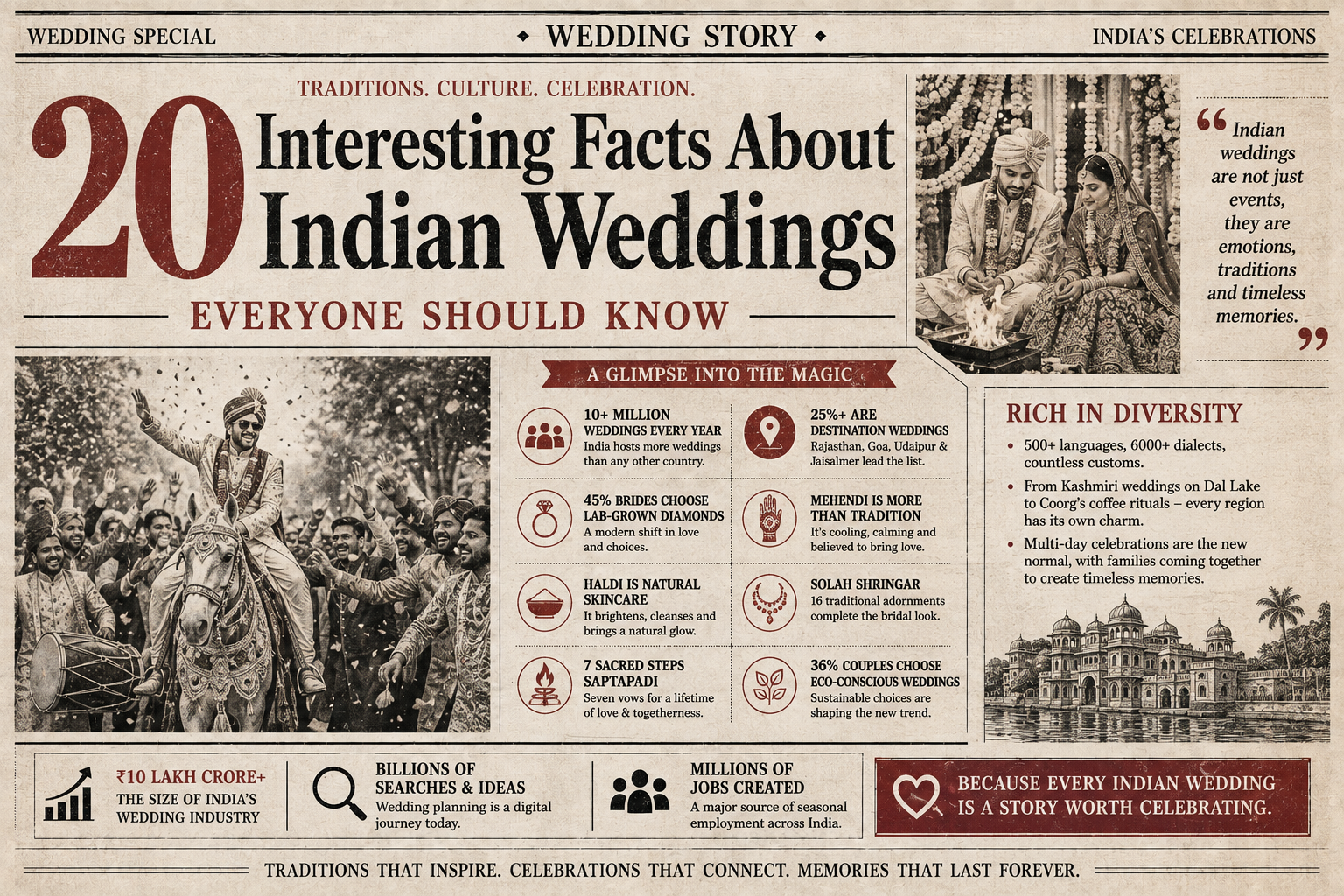
20 Interesting Facts About Indian Weddings Everyone Should Know
Indian weddings are one of the most-watched, most-photographed, most-talked-about celebrations on earth — and yet most people, including a lot of Indians, only know the surface version: colorful, loud, multi-day, a lot of food. The real story underneath is stranger, bigger, and more interesting than that. Here are 20 facts worth knowing, whether you’re planning a wedding, attending one, or just curious about the celebration behind the spectacle.
The Scale Will Surprise You
1. India hosts more weddings than any other country on earth. Estimates consistently put the number at over 10 million ceremonies a year — that’s roughly 27,000 weddings happening across the country on an average day.
2. It’s one of the largest industries in the country, full stop. Depending on which industry body’s estimate you use, India’s wedding economy is valued anywhere from roughly $130 billion to well over ₹10 lakh crore annually — figures vary by what’s counted, but every serious estimate places it among the largest consumption sectors in the country, alongside sectors like retail and agriculture.
3. Roughly a quarter of Indian weddings are now destination weddings. Industry estimates put the figure between 21% and 27%, and the segment is growing far faster than traditional home weddings — with Udaipur, Jaipur, Goa, and Jaisalmer consistently topping the destination lists.
4. The average destination wedding costs dramatically more than a home wedding. Recent industry survey data puts the average destination wedding budget at around ₹58 lakh — and 60% of all weddings budgeted above ₹1 crore are destination celebrations.
5. Jewellery alone is a wedding-driven economy of its own. Wedding-related jewellery spending is estimated at around ₹60,000 crore annually in India, accounting for roughly half of the entire domestic jewellery market’s revenue.
6. Lab-grown diamonds have quietly taken over engagement rings. As of 2023–24, close to half of Indian brides — an estimated 45–46% — chose a lab-grown diamond for their engagement ring over a traditionally mined stone, a dramatic shift from even five years earlier.
Traditions With Meanings Most People Never Learn
7. The bride’s mehendi shade is supposedly a love forecast. Popular belief holds that a darker mehendi stain means deeper affection from the in-laws and husband. The real, more grounded reason mehendi is applied has nothing to do with fortune-telling — the paste is genuinely antiseptic and has a calming, stress-relieving effect, which is exactly what a bride needs the night before her wedding.
8. Only women attend the mehendi ceremony, traditionally. It’s one of the few major wedding functions historically reserved as a women-only space — a night of music, henna, and celebration among the bride’s female relatives and friends before the rest of the wedding begins.
9. Haldi isn’t just symbolic — it’s practical skincare. The turmeric, oil, and water mixture applied to the couple during the haldi ceremony is believed to bless them, but it also genuinely brightens and moisturizes the skin before the wedding day — making it one of the only wedding rituals with a real, measurable cosmetic benefit.
10. Indian brides almost never wear white. Unlike Western tradition, red, yellow, and orange are the colors most associated with Indian bridal wear — white is traditionally associated with mourning in several Indian communities, making it one of the most-asked “why don’t they” questions from anyone new to Indian weddings.
11. A traditional bridal look isn’t one outfit — it’s sixteen elements. Known as Solah Shringar (literally “sixteen adornments”), the traditional complete bridal look includes specific jewellery, makeup, and clothing elements for nearly every part of the body — from the maang tikka on the forehead to the mehendi on the hands and feet.
12. The wedding vows involve seven literal steps. In Hindu wedding ceremonies, the couple takes seven steps around a sacred fire — the Saptapadi — with each step representing a specific vow: nourishment, strength, prosperity, wisdom, family, and finally, lifelong friendship and unity. It’s one of the most consistent rituals across Hindu wedding traditions nationwide, even as everything else varies by region.
13. The baraat is technically the groom’s entrance parade — and it’s louder than most people realize. The groom’s procession to the wedding venue, traditionally on a horse or elephant, accompanied by dancing family and a dhol drummer, exists specifically to announce his arrival — and in many communities, the more elaborate and joyful the procession, the more it’s considered a mark of celebration and family pride.
The Diversity Nobody Talks About Enough
14. “An Indian wedding” isn’t really one thing. With over 500 languages and roughly 6,000 dialects spoken across the country, wedding customs shift dramatically by region, religion, and community — a Bengali wedding, a Kashmiri Nikah, and a Tamil Hindu wedding can look almost nothing alike, despite all being “Indian weddings.”
15. Coorg weddings have a coffee ritual you won’t find anywhere else in India. In Coorg (Kodagu), Karnataka, weddings feature distinctive customs including a specific dance tradition and a coffee-serving ritual, alongside regional dishes like pandi curry — a reflection of just how hyper-local Indian wedding food and custom traditions really are.
16. Kashmiri weddings have taken place on water. Weddings in Kashmir have been hosted around Dal Lake’s floating markets, blending the region’s distinct geography directly into the celebration itself — a striking example of how Indian weddings adapt to, rather than override, local landscape and culture.
17. Multi-day weddings are getting even longer, not shorter. Industry data shows the average duration of a luxury Indian wedding has grown from roughly 2.1 days in 2019 to considerably longer multi-day experiences by 2026, as families increasingly treat the wedding as a multi-event celebration rather than a single ceremony.
Facts That Are Just Genuinely Fun
18. Wedding planning has become a search-engine phenomenon. Global platforms have recorded billions of wedding-related searches and tens of billions of wedding ideas saved in a single year — Indian weddings are researched, planned, and inspired online more intensively than almost any other life event.
19. More than a third of couples are now choosing eco-conscious celebrations. Over 50% of couples in recent survey data report opting for at least some eco-conscious wedding choices, and around 36% are choosing to rent rather than buy wedding jewellery — a real shift from the “bigger is better” wedding stereotype.
20. The wedding industry is also one of India’s biggest seasonal employers. Beyond the couples and families, the wedding economy supports a vast seasonal workforce — decorators, caterers, musicians, tailors, and logistics teams — with estimates placing rural, seasonal wedding-industry employment in the millions during peak wedding months.
Why This Matters Beyond Trivia
These aren’t just fun facts to drop at your next dinner party (although they absolutely work for that too). They’re a reminder of something genuinely useful if you’re planning your own wedding: Indian weddings are simultaneously one of the most tradition-bound and most rapidly evolving celebrations in the world. The rituals carry centuries of meaning, and the industry around them is innovating faster than almost any other consumer sector in the country — from lab-grown diamonds to destination weddings to eco-conscious celebrations that didn’t really exist as a mainstream choice a decade ago.
Whatever kind of wedding you’re planning — deeply traditional, thoroughly modern, or (like most weddings today) some thoughtful blend of both — you’re part of something with genuine scale and genuine meaning behind it.
Plan Yours With People Who Know Both the Traditions and the Trends
At AKK, we plan weddings that honor the rituals that matter to your family while keeping up with where Indian weddings are actually headed — destination celebrations, sustainable choices, multi-day experiences, and everything in between. Get in touch with our team to start planning yours.
Add Comment