
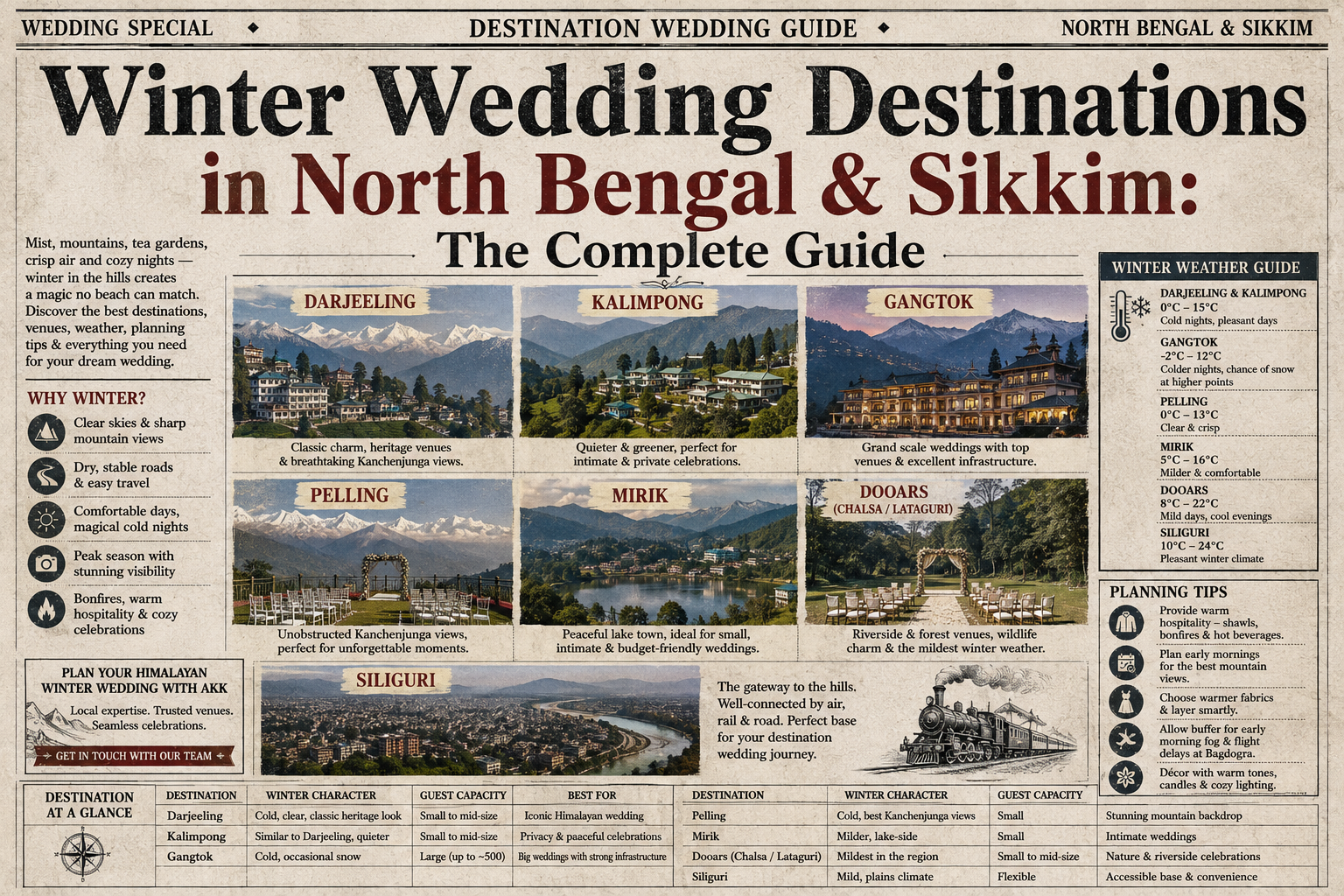
Winter Wedding Destinations in North Bengal & Sikkim: The Complete Guide
Most of India thinks of a destination wedding and pictures a beach. But for a genuinely different kind of magic — mist rolling over tea gardens at dawn, Kanchenjunga turning gold at sunrise, a bonfire crackling while guests wrapped in shawls dance until midnight — nothing quite matches a winter wedding in the hills of North Bengal and Sikkim.
Winter here isn’t just tolerable, it’s the actual peak season for a reason: this is when the skies are at their clearest, the mountain views are at their sharpest, and the weather is genuinely comfortable rather than something to work around. If you’re considering the hills for your wedding, here’s the complete picture — where to look, what winter actually feels like at each destination, and what to plan for.
Why Winter Is the Right Season for a Hill Wedding Here
North Bengal and Sikkim run through a monsoon that makes outdoor weddings genuinely risky between June and September — heavy rain, landslide risk on mountain roads, and low visibility that can hide the very mountain views you’re paying for. Winter (roughly late October through February) flips all of that:
- Clear skies and sharp mountain views. This is when Kanchenjunga is most reliably visible, especially in the early morning before any afternoon haze builds up.
- Dry, stable roads. Landslide risk drops dramatically compared to monsoon season, making hill-road travel between venues far more predictable.
- Comfortable daytime temperatures. Days are crisp and sunny in most of the region; it’s the nights that get genuinely cold, which is a planning consideration, not a dealbreaker.
- Peak tourist season alignment. Hotels and resorts are fully operational, staffed, and ready — unlike monsoon season when some properties scale back.
- A visual mood no other season offers. Winter light in the Himalayan foothills has a golden, low-angle quality that’s simply different from anywhere else on a typical Indian wedding circuit.
The trade-off is real cold — genuinely near-freezing nights at higher elevations like Darjeeling and Gangtok — which needs to be planned for, not ignored. More on that below.
Darjeeling: The Classic Choice
Darjeeling remains the most recognizable hill wedding destination in the region, and for good reason — colonial-era heritage properties, rolling tea gardens, and some of the most photographed mountain views in India.
What winter looks like: Cold, clear, and genuinely photogenic. Early morning temperatures can dip close to freezing, while daytime is crisp and sunny. Tiger Hill’s sunrise view of Kanchenjunga is at its best in winter’s clear conditions, and several properties are positioned to capture that view directly from the venue itself.
Venues worth knowing: Darjeeling’s wedding venue scene ranges from heritage colonial hotels to purpose-built resort properties. Summit Swiss Heritage Resort & Spa is known for Himalayan panoramas and sunrise views of Tiger Hill directly from its sundeck. The Windamere Hotel offers a colonial-era hilltop setting with panoramic valley views and banquet space for up to around 200 guests. Sterling Darjeeling sits at one of the town’s highest points with sweeping Kanchenjunga views, well suited to intimate ceremonies.
Best for: Couples who want the classic, most-photographed version of a Himalayan wedding, with strong heritage character and easy access to Darjeeling’s tea garden and Chowrasta backdrops for photography.
Kalimpong: Quieter, Greener, Less Crowded
About an hour from Darjeeling, Kalimpong offers a similar hill-station character with noticeably fewer crowds and a more laid-back pace — a genuine advantage for couples who want the Himalayan setting without Darjeeling’s peak-season tourist density.
What winter looks like: Similar cold-clear pattern to Darjeeling, generally a touch milder, with lush greenery that stays vivid even in the dry winter months.
Venues worth knowing: Summit Barsana Resort & Spa is a well-regarded Kalimpong wedding venue nestled in the hills, offering a blend of nature-forward setting and resort comfort.
Best for: Couples who love the hill-wedding aesthetic but want more privacy and a quieter, less touristy backdrop than Darjeeling proper.
Gangtok: Sikkim’s Grand-Scale Option
Sikkim’s capital is where hill weddings go genuinely large-scale — this is the region’s best option for weddings needing significant guest capacity, alongside dramatic Himalayan views.
What winter looks like: Cold, often colder at night than Darjeeling given the elevation, with excellent visibility on clear days. Snowfall is possible at higher points around Gangtok in peak winter, though the town itself sees it less often than areas further north in Sikkim.
Venues worth knowing: Mayfair Spa Resort and Casino is one of Gangtok’s most established wedding venues, with banquet space accommodating up to roughly 500 guests and gardens suited for outdoor ceremonies. Elgin Nor-Khill offers a heritage boutique setting with a more intimate, elegant character for smaller celebrations.
A practical note for Sikkim specifically: while an Inner Line Permit isn’t required for Indian citizens visiting Gangtok itself, some more remote parts of Sikkim do require permits — worth confirming with your planner if any part of your wedding itinerary extends beyond the main Gangtok circuit.
Best for: Larger weddings that want a genuine mountain-state setting with strong infrastructure and high guest capacity.
Pelling: The View Nobody Talks About Enough
Pelling gets far less attention than Darjeeling or Gangtok, which is exactly its appeal — it offers some of the most direct, unobstructed Kanchenjunga views in the entire region, without the crowds.
What winter looks like: Cold and clear, with the same dry-season visibility advantages as the rest of the region, arguably at their most dramatic here given Pelling’s closer, more head-on angle to the Kanchenjunga range.
Best for: Couples prioritizing the single most spectacular mountain backdrop over convenience or scale — Pelling is quieter and less developed, which suits an intimate wedding better than a very large one.
Mirik: The Underrated Small-Wedding Option
A smaller hill town built around Mirik Lake, Mirik offers a gentler, more accessible alternative for couples who want the hill-station feel without committing to a longer, higher-altitude journey.
What winter looks like: Milder than Darjeeling or Gangtok given its lower elevation, with clear lake views and a calmer, less touristy atmosphere through the winter months.
Best for: Smaller, more intimate weddings, or as a scenic add-on day (a couple’s shoot or a smaller pre-wedding function) alongside a larger celebration elsewhere in the region.
The Dooars: A Completely Different Kind of Winter Wedding
If the classic hill-station look isn’t quite what you want, the Dooars — the forested foothill belt stretching through Jalpaiguri district, including areas like Chalsa and Lataguri — offers something genuinely different: riverside and forest-edge venues, wildlife-adjacent settings near Gorumara and Chapramari, and a quieter, more nature-immersive winter wedding experience.
What winter looks like: Noticeably milder than the higher hill stations, with crisp mornings, comfortable days, and none of the near-freezing nights you’d get in Darjeeling or Gangtok — genuinely the most guest-comfortable winter option in the region.
Best for: Couples who want a nature-forward, forest-and-river setting rather than a mountain-town backdrop, and for guests who might struggle with higher-altitude cold or thinner air.
Siliguri: The Practical Gateway
Siliguri itself isn’t typically the scenic centerpiece of a hill wedding, but it’s worth understanding its role: as the region’s transport hub — home to Bagdogra Airport and the main road and rail gateway into both North Bengal’s hills and Sikkim — it’s often where logistics genuinely happen, even for a wedding actually held higher up. For couples wanting a straightforward, accessible venue without a further hill journey, Siliguri also has its own banquet and hotel venue options.
Comparing the Region at a Glance
| Destination | Winter Character | Guest Capacity | Best For |
| Darjeeling | Cold, clear, classic heritage look | Small to mid-size (most venues) | The most iconic, photographed Himalayan wedding |
| Kalimpong | Similar to Darjeeling, quieter | Small to mid-size | Privacy and a less touristy hill setting |
| Gangtok | Cold, occasional snow at elevation | Large (up to ~500 at top venues) | Bigger weddings needing scale and infrastructure |
| Pelling | Cold, best direct Kanchenjunga views | Small | Couples prioritizing the single best mountain view |
| Mirik | Milder, lake-side | Small | Intimate weddings or an add-on scenic day |
| Dooars (Chalsa/Lataguri) | Mildest in the region | Small to mid-size | Forest/riverside setting, easier on guests |
| Siliguri | Mild, plains climate | Flexible | Accessible base without a further hill journey |
Planning Around Winter Specifically
1. Guest comfort is a real planning line item, not an afterthought. Near-freezing nights in Darjeeling or Gangtok genuinely catch out-of-town guests off guard, especially anyone traveling from warmer parts of India. Build in heated tents or indoor backup spaces for evening functions, provide shawls or stoles as part of your welcome kit, and set up a hot-beverage or soup station that runs through the evening, not just at the start.
2. Outfits need practical adaptation, not just aesthetic planning. Heavier fabrics — velvet, brocade, silk with warmer layering — work better than lightweight chiffon for winter hill weddings. It’s worth discussing this directly with your outfit designer if your wedding is happening here rather than assuming a standard bridal lehenga will translate comfortably to near-freezing temperatures.
3. Morning fog can affect flights into Bagdogra. Winter mornings, particularly December and January, can bring fog delays for flights landing at Bagdogra Airport, the main gateway to the region. Build a buffer day into your guest travel schedule rather than scheduling arrivals the same day as key functions.
4. Sunrise events need real commitment, but they’re worth it. If a Kanchenjunga sunrise moment is part of your plan — whether a couple’s shoot or an actual ceremony — winter is genuinely the best season for it, but it requires an early call time and a venue or viewpoint with a reliable, unobstructed angle. Confirm this specifically with your planner rather than assuming any hill-facing venue works equally well.
5. Décor should lean into the season, not fight it. Warm-toned florals, candlelight, bonfires, and rich fabric drapes suit the winter hill aesthetic far better than the bright tropical palettes common at beach destinations — winter here is an asset to design around, not a limitation to hide.
Frequently Asked Questions
What’s the actual best month for a winter wedding in this region? November through early February generally offers the clearest skies and most stable weather, though December and January bring the coldest nights — worth weighing view quality against guest comfort when picking an exact date.
Do I need any special permits for a Sikkim wedding? Gangtok itself doesn’t require an Inner Line Permit for Indian citizens, but some other parts of Sikkim do — confirm with your planner if your itinerary extends beyond the main Gangtok area.
Which destination is best for a large wedding (300+ guests)? Gangtok has the strongest infrastructure and largest banquet capacity in the region; Darjeeling and Kalimpong generally suit small-to-mid-size weddings better.
Is the Dooars actually a good wedding destination, or just a consolation option? It’s a genuinely distinct, strong option in its own right — milder winter weather, forest and riverside settings, and easier for guests who might struggle with higher-altitude cold, not simply a fallback if the hills don’t work out.
Plan Your Himalayan Winter Wedding With AKK
We’re based right in this region, which means we’re not planning your Darjeeling or Gangtok wedding from a spreadsheet in another city — we know which venues actually deliver the Kanchenjunga view they promise, which roads to avoid in early winter fog, and how to keep 200 shivering-but-thrilled guests comfortable at a mountaintop reception. Get in touch with our team to start planning your winter hill wedding.
Add Comment